
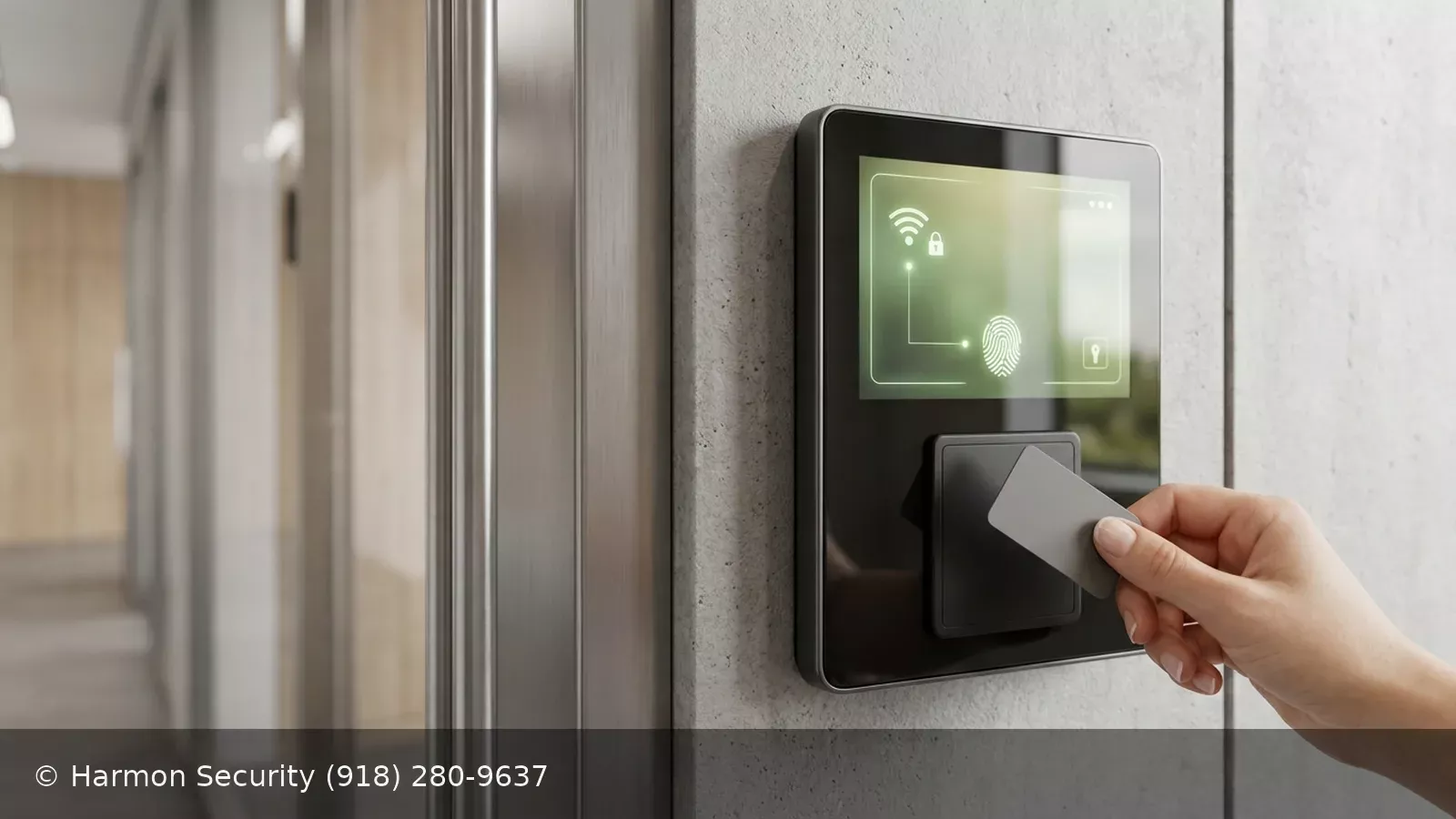
 Featured image
What Is Access Control System Network Security?
An access control system network security architecture links physical controllers with network rules like 802.1X, VLANs, and TLS. These systems stop unauthorized site and network entry. Deployments cost $1,500 to $3,500 per door or endpoint. Costs depend on hardware, cloud choices, MFA, and compliance rules.
Firms buy deadbolts, gates, and turnstiles. Yet physical barriers fail when attached devices lack monitoring. Modern card readers, boards, and IP cameras are active computing endpoints. When building operations connect to IT without isolation, physical entry points turn into digital back doors. Through our expert security consulting services, Harmon Security Group LLC partners with Bryant Technology Solutions. Together, we deliver access control system network security to shield physical doors and digital network infrastructure under one clear agreement.
Defining Physical vs. Logical Access Control Integration
In modern sites, physical guards and logical security can no longer operate in silos. What is access control in security guard operations? In guarding, access control means officers check visitor credentials, enforce post orders, and manage entry gates. In network security, logical access control governs user privileges across IP subnets, databases, and cloud platforms.
Merging these domains creates cyber-physical safety. When a worker scans a badge at a gate, system rules check the user in Microsoft Entra ID or Okta. They check device certificates via Network Access Control (NAC). The system grants entry and logs the event across physical and digital audit trails.
How IP Door Controllers and Smart Readers Connect to IT Networks
Old entry setups used isolated serial lines. Today, sites rely on IP door controllers and PoE smart readers wired to network switches. Each IP controller acts as a small server running embedded Linux or custom code. It holds encrypted user lists and makes instant entry decisions.
These devices need constant network links to update access logs and rights. Thus, they need strong ethernet wiring. Without network defense, an outdoor ethernet line gives intruders a direct path into your switch stack. Maintaining strong access control system network security ensures these connections stay safe.
Critical Cyber-Physical Vulnerabilities in Access Networks
Weak network setups expose facility sites to hardware taps, card cloning, and network sniffing. An IP badge reader is a networked computer running code, holding data, and talking to a board. An unmonitored reader allows bad actors to intercept data easily.
Facility managers rarely view these devices as computers. That lack of focus creates key risks. Common threats include exposed exterior RJ45 drops for rogue laptops, raw wiring runs between readers and boards, and unpatched controller firmware. Strong access control system network security helps prevent these gaps.
+-----------------------------------------------------------------------------------------+
|                        ATTACK VECTOR COMPARISON: WIEGAND VS. OSDP                       |
+-----------------------+----------------------------------+------------------------------+
| Feature / Threat      | Legacy Wiegand Protocol          | SIA OSDP v2.2 Standard       |
+-----------------------+----------------------------------+------------------------------+
| Encryption            | None (Cleartext binary transmission)| AES-128 Encryption           |
| Communication Type    | Unidirectional (Reader -> Board) | Bidirectional (Reader <-> Board)|
| Wire-Tapping Risk     | High (In-line hardware sniffers) | Mitigated (Cryptographic session)|
| Tamper Detection      | Unsupported                      | Real-time supervised signal  |
| Firmware Updates      | Manual chip replacement          | Secure remote patch deployment|
+-----------------------+----------------------------------+------------------------------+
Legacy Wiegand vs. OSDP v2.2 Encryption Standards
For years, security systems used legacy Wiegand protocol to pass card data to door boards. Wiegand sends raw binary data in cleartext over multi-wire cables. An attacker with a cheap $20 tap behind an outer reader can steal card details. They can replay signals to unlock doors without approval.
Modern setups require SIA OSDP v2.2 standards. OSDP v2.2 uses AES-128 encryption to safeguard reader-to-board traffic. OSDP also provides constant two-way checks. It spots cut wires, removed readers, or tapping tools instantly. Using access control system network security standards protects reader channels.
Preventing Edge Device Exploits on IP Access Panels
Industrial sites need proper tools to catch unpatched boards across outer perimeter zones. Unpatched OEM controller boards are easy targets. Vendors ship hardware with default passwords, and teams skip patch updates.
Unsecured controllers run legacy web protocols like unencrypted HTTP, Telnet, or weak SNMP tools. An attacker on an edge board can execute code to take root control. They dump card databases or move onto the shared corporate VLAN. From there, they target financial data, payroll systems, and core tools. Strict access control system network security stops lateral movement.
Network Security Architecture for Physical Access Systems
Network Segmentation: Isolating Access Control on Dedicated VLANs
Insurance firms now demand clear defense before writing policy terms for large sites. When badge readers, cameras, and HVAC gear share network lines with core business tools, any breach spreads fast. An attacker taking over an outer camera is one step from core files. Modern teams use access control system network security to segment all devices.
[ Enterprise IT Network / Corporate VLAN ]
                    | (Firewall / Zero Trust Isolation)
                    v
[ Dedicated Access Control VLAN ] <--- (802.1X RADIUS Authentication)
  ├── IP Door Controller Stack (PoE+ Switches)
  ├── SIA OSDP v2.2 Encrypted Smart Readers
  └── Hardware Security Modules / PKI Certificates
Strong defense relies on strict network isolation. Every access point—controllers, readers, and cameras—must sit on dedicated, non-routable VLANs. Strict Access Control Lists (ACLs) on firewalls must stop physical security endpoints from contacting corporate PCs or the public web. What is the purpose of an access control list (ACL) in networking? An ACL filters network traffic, letting only safe ports (like HTTPS port 443 or encrypted RADIUS) talk to management IP addresses. Good protection keeps these paths isolated.
Need this handled today? Talk to a local expert in minutes.
Call (918) 280-9637Implementing 802.1X Port Security, RADIUS, and PKI Certificates
Enforcing 802.1X port checks provides the core base for access control system network security across enterprise campuses. What is the primary purpose of NAC? Network Access Control (NAC) enforces security rules by checking device ID before opening switch ports.
With 802.1X active: - Every controller and camera must show a PKI certificate or RADIUS proof before the port opens. - If an attacker unplugs an outer reader to connect a laptop, the switch port shuts down at once. - MAC-based RADIUS bypass (MAB) is limited to legacy gear and pairs with MAC spoof checks.
Integrating Access Control with Zero Trust and Identity Providers (Entra ID, Okta)
Old access models relied on static user groups or custom rules. What is discretionary access control? Discretionary Access Control (DAC) is a model where owners grant entry rights to individuals. Yet DAC fails at scale and leaves old active accounts behind.
Modern setups apply Zero Trust rules. They sync local door hardware with Identity Providers (IdPs) like Microsoft Entra ID or Okta. Role-Based Access Control (RBAC) revokes door access as soon as HR marks an employee as departing. This eliminates delays between digital removal and door access. Upgraded access control system network security ties physical access to identity management.
Access Control Network Pricing and Cost Breakdown
Planning budgets for physical security updates requires reviewing per-door hardware, cabling, and software costs.
| Expense Category | Itemized Component Description | Estimated Benchmark Cost | Tax & Financial Offset |
|---|---|---|---|
| Per-Door Hardware | Smart Reader (OSDP v2.2), Electrified Lock/Strike, Request-to-Exit (REX) Sensor, Door Contact | $800 - $1,800 per door | Eligible for IRS Section 179 Instant Deduction |
| IP Controller & Power | Multi-door IP Controller Board, Structured CMP Cabling, PoE+ Switch Port Allocation | $400 - $1,000 per door | IRS Section 179 Qualified Property |
| Installation & Labor | CLEET-Licensed Technician Field Labor, Low-Voltage Cabling, Switch Configuration, Testing | $300 - $700 per door | Operating Expense / Capital Expense |
| Cloud Management SaaS | Cloud Access Software License (per door) | $5 - $15 / door / month | Standard Operating Expense (OpEx) |
| Mobile Credentials | Bluetooth / NFC Smartphone Credential Licensing | $2 - $5 / user / year | Standard Operating Expense (OpEx) |
Sizing Controllers, PoE Power Budgeting, and UPS Backup Requirements
Building safe power plans for network access control requires meeting NFPA 731 standards. Enterprise rules require: 1. Controller Capacity: 1 multi-door panel per 4 to 8 doors in locked tech rooms. 2. PoE Budgeting: Dedicated managed PoE+ (802.3at) switch ports giving up to 30W per port for door locks and readers. 3. Battery Backup Sizing: Central Uninterruptible Power Supply (UPS) setups giving at least 4 hours of backup power during power outages.
Commercial building owners upgrading access control system network security hardware can use the IRS Section 179 tax deduction. This rule allows a full first-year deduction for qualified physical security equipment.
Regulatory Compliance and System Hardening Guidelines
Meeting NDAA Section 889 and UL 294 Physical Security Standards
Federal rules and building codes state clear physical access rules: - UL 294 Standard: Ensures door units pass break-in tests, power safety checks, and line security rules. - NDAA Section 889 Compliance: Prohibits entities from using physical security gear from banned foreign vendors (such as Dahua or Hikvision). - FCC Part 15 Class A: Limits electromagnetic interference from digital controllers.
Aligning Door Security with HIPAA, SOC 2, and NERC CIP Frameworks
Door security directly influences IT compliance audits: - HIPAA Physical Safeguards: Requires locked doors and full access logs for room housing health data (ePHI) or servers. - SOC 2 Type II (Trust Services Criteria): Demands proof of door security, visitor logs, and quarterly access reviews. - NERC CIP Standards: Mandates clear physical security perimeters (PSP) around critical cyber assets, enforced by MFA readers and 24/7 logs.
Maintenance Benchmarks: Convergence Security Checklist
Follow these simple steps to keep access control system network security protocols strong across all doors: - Segment all cameras, readers, and controllers onto separate access VLANs away from office networks. - Disable unused switch ports and lock outer RJ45 jacks to stop rogue hardware attachments. - Replace default passwords on every board with strong, rotated passwords. - Upgrade legacy Wiegand cabling to SIA OSDP v2.2 with AES-128 encryption. - Enforce 802.1X port checks so only approved hardware connects to switch ports. - Patch controller firmware on a regular quarterly schedule with clear device inventories. - Log and review access events from card readers and IT networks to catch unusual events early. Maintain high standards for physical and digital defense.
Defend the Door and the Network Behind It
Unmonitored readers and cameras create easy entry paths for attackers. Leaving door controllers unsegmented leads to financial losses, insurance risks, and compliance audit failures. Most security vendors solve only half of the issue. Traditional guard firms lack network security skills. Meanwhile, standard IT vendors rarely work with physical lock hardware or low-voltage field wiring.
Harmon Security Group LLC and Bryant Technology Solutions solve both sides under one complete agreement. Our CLEET-licensed security officers handle posts, patrols, and post orders. Our technical team isolates building networks using VLAN setup, 802.1X port enforcement, and firmware updates. We support commercial, corporate, and industrial sites across Oklahoma, Texas, Arkansas, Kansas, and Missouri. Our main office sits at 2135 S 130th E Ave, Tulsa, OK 74134.
We provide full access control system network security to shield your property. Contact our team today to schedule a convergence security assessment and eliminate technical blind spots across your physical and digital perimeters.
Harmon Security
2135 S 130th E Ave, Tulsa, OK 74134
Call (918) 280-9637 to request your convergence security assessment today.